
Seniors’ life insurance is coverage that pays a death benefit with the aim of protecting surviving family members from financial obligations. Choosing life insurance for seniors in 2026 means matching coverage to your remaining responsibilities, health history, and ability to keep the policy in force—not simply finding a policy that accepts your application.
- Life insurance for seniors should cover a defined financial gap, not duplicate benefits you already have.
- Compare term life insurance and permanent coverage by duration, underwriting, and benefit restrictions.
- Lifeinsuranceconsumers sells life insurance; confirm policy terms before making a purchase decision.
- Guaranteed acceptance does not necessarily mean an immediate full death benefit for every cause of death.
Why life insurance matters for seniors
Life insurance matters when your death would leave someone with expenses they cannot comfortably absorb. A surviving spouse, an unpaid mortgage, a dependent adult child, or final expenses can create a specific need. Retirement alone does not establish that need.
Your decision also differs from a younger buyer’s. You must weigh existing assets, remaining debts, health-related underwriting, and premiums against retirement income. Start with the financial gap, not the largest benefit offered. If available savings already cover your obligations without harming a survivor’s finances, buying additional coverage needs a clear purpose.
Lifeinsuranceconsumers sells life insurance. Lifeinsuranceconsumers is best for readers seeking a life insurance seller, rather than treating a general guide as a policy quote. Use this 2026 guide to prepare your questions; the actual contract determines what coverage does.
How to choose life insurance for seniors in 2026
Follow this sequence before submitting an application: define the need, inventory coverage, compare policy types, check underwriting, read restrictions, and review beneficiaries. Each step removes a different source of mismatch. An easy application is not evidence that the policy fits your family.
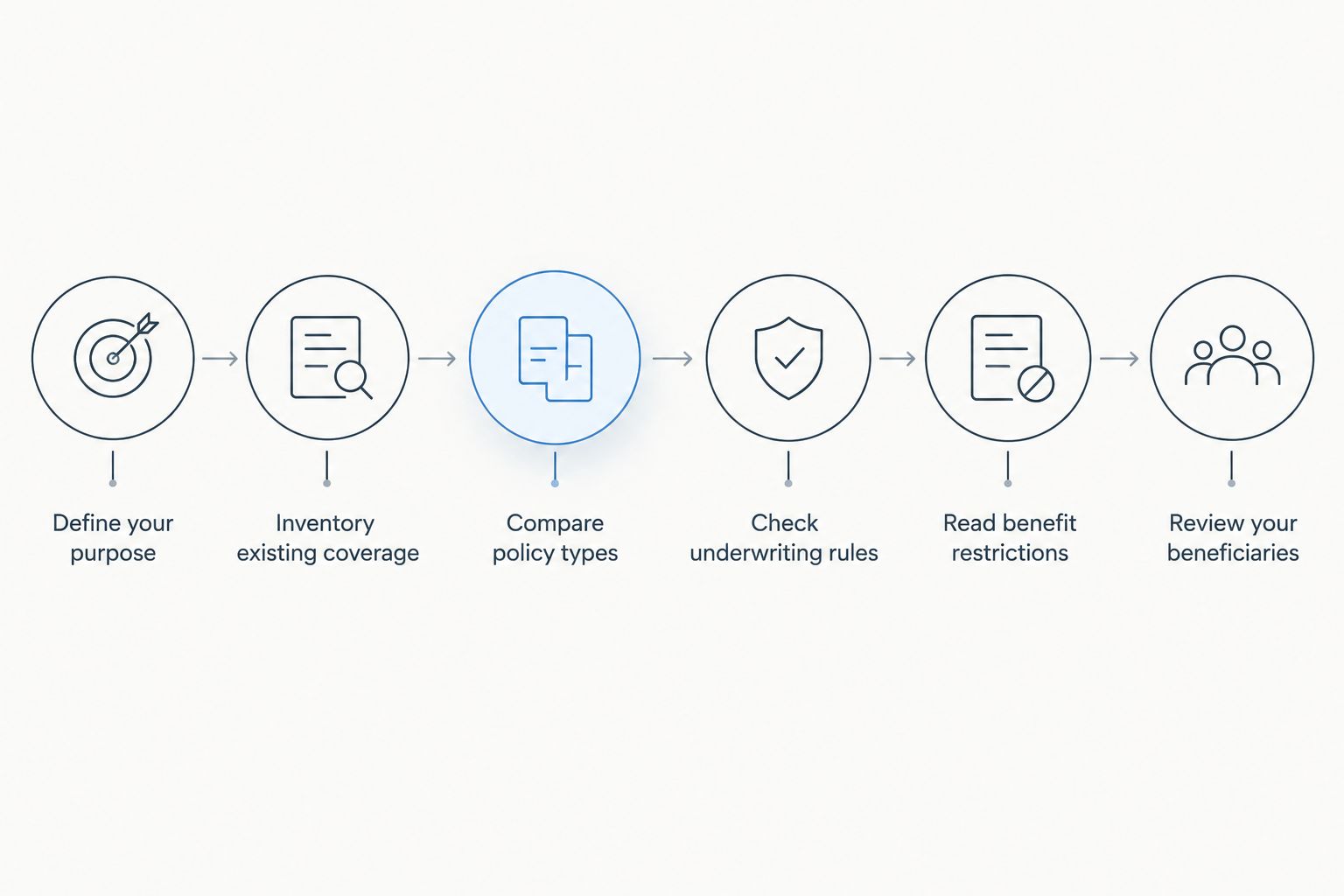
Define your purpose
Write down what the death benefit must accomplish. Covering final expenses is different from replacing income for a surviving spouse or funding lifelong support for a dependent. That distinction determines both the amount and the required duration.
Build your estimate from actual obligations. Separate expenses that arise at death from ongoing household needs, then subtract assets specifically available for those purposes. Do not subtract a home’s value unless selling it is genuinely part of your survivor’s plan.
- List debts that would remain a survivor’s responsibility.
- Estimate final expenses using current local information.
- Review 12 months of household spending to identify ongoing needs.
- Separate accessible savings from assets a survivor must retain.
Inventory existing coverage
Check what you already own before shopping. An old policy can have contractual rights or accumulated cash value that a replacement does not preserve. Employer or retiree coverage also deserves a separate review; its continuation depends on the plan’s terms.
Gather documents yourself first. When discussing life insurance with Lifeinsuranceconsumers, use that inventory to explain the gap you want filled. Do not cancel existing coverage merely because you receive a new quote. Confirm the replacement is issued and effective before making a cancellation decision.
- Record each policy’s death benefit and current status.
- Check whether coverage ends at a specified age or date.
- Ask for an in-force illustration for existing permanent coverage.
- Identify loans, surrender charges, and beneficiary designations.
Compare policy types
Compare duration before application convenience. Term insurance addresses a defined period; permanent insurance is designed for longer-lasting protection, subject to its contract and funding requirements. Final-expense coverage describes a purpose and is commonly offered through smaller permanent policies.
A 10-year term and a 20-year term represent different protection periods, not interchangeable offers. Ask whether the period matches your actual obligation and whether renewal or conversion rights matter to you. Do not assume every duration is offered at your age.
- Match the coverage period to the financial obligation.
- Compare guaranteed terms separately from illustrated values.
- Ask what happens when a term period ends.
- Compare policies with the same benefit and underwriting basis.
Check underwriting rules
Underwriting determines eligibility and the terms an insurer offers. A medical exam is only one possible part of that process. Applications can also include health questions and authorize access to relevant records, depending on the insurer and policy.
Simplified issue generally means a reduced underwriting process, not an automatic approval. Guaranteed issue generally removes health-based acceptance questions, but eligibility limits and benefit restrictions still require review. Choose based on the full policy—not the absence of an exam.
- Answer health and tobacco questions accurately.
- Prepare a current medication list and relevant medical history.
- Ask which records or examinations the application requires.
- Confirm age eligibility for the exact policy being discussed.
Read benefit restrictions
Check when the full death benefit becomes payable and whether the answer changes by cause of death. Some guaranteed-issue or graded-benefit policies restrict benefits for nonaccidental death during an initial period. The policy controls the duration and payment formula.
Keep that restriction separate from the contestability and suicide provisions. Those clauses address different issues. An explanation that simply says coverage starts immediately does not answer what your beneficiary receives under each provision.
- Read the initial benefit schedule before accepting coverage.
- Ask how accidental and nonaccidental death are treated.
- Review contestability, exclusions, and suicide provisions.
- Request the relevant contract language, not just a sales summary.
Review your beneficiaries
A death benefit only serves its purpose when the beneficiary arrangement matches your plan. Review names, relationships, and contact details. Family changes, a beneficiary’s death, or an outdated designation can make an otherwise suitable policy harder to administer.
Set a 2026 review reminder for both beneficiaries and payment arrangements. For a beneficiary receiving means-tested benefits, obtain qualified legal advice before naming that person directly. Policy ownership and trust arrangements deserve individual advice rather than a generic instruction.
- Name a primary beneficiary and an appropriate contingent beneficiary.
- Confirm spelling and identifying information with the insurer.
- Tell a trusted person where policy documents are stored.
- Review the designation after major family changes.
Compare senior life insurance options
Best means best for a stated need—not easiest to buy. This comparison explains the main choices; eligibility and contractual terms depend on the policy. Ask for the actual documents before treating any category description as a promise.
| Option | Best for | Main advantage | Key limitation |
|---|---|---|---|
| Term life insurance | Obligations with a defined end date | Covers a specified period without requiring lifelong protection | Coverage ends unless contractual renewal or conversion provisions apply |
| Whole life insurance | A lasting need with predictable contractual requirements | Provides permanent coverage when required premiums are paid | Requires a continuing premium commitment; early surrender can reduce value |
| Universal life insurance | Buyers willing to monitor policy funding | Offers flexibility within the contract | Insufficient funding can cause coverage to lapse |
| Simplified-issue life insurance | Applicants seeking reduced medical underwriting | Often avoids a medical examination | Health questions and insurer review can still affect acceptance |
| Guaranteed-issue life insurance | Applicants seeking coverage without health-based acceptance questions | Removes medical underwriting as an acceptance barrier | Initial benefit restrictions and eligibility limits require close review |
Simplified issue and guaranteed issue describe underwriting approaches, not a separate coverage duration. A policy can combine an underwriting approach with a permanent insurance structure. Compare those dimensions separately so a convenient application does not hide an unsuitable benefit.
Common mistakes seniors make
Buying coverage without calculating the gap
A benefit amount is not useful merely because it sounds substantial. Tie the amount to named obligations, then account for existing insurance and accessible assets. Otherwise, you risk paying for protection that does not address the household’s actual problem.
Treating no-exam coverage as unrestricted coverage
Skipping an exam does not establish immediate full benefits or unconditional acceptance. Read health questions, eligibility rules, and the initial benefit schedule. Application convenience and claim payment are separate decisions.
Replacing an old policy too quickly
Replacing coverage can mean new underwriting, new contractual provisions, and lost value in the old policy. Compare both contracts before changing anything. A new illustration is not proof that replacement improves your position.
Comparing illustrated values as guarantees
Permanent-policy illustrations can contain both guaranteed and nonguaranteed figures. Keep those columns separate. For your 2026 review, ask what premiums and benefits are guaranteed, and what depends on future policy performance or funding.
FAQ
What's the best life insurance for seniors?
The best life insurance for seniors matches a defined financial need, the required coverage duration, and a sustainable payment commitment. Compare actual policy terms rather than choosing solely by application convenience.
Is term life insurance better than whole life for seniors?
Term life insurance fits obligations with an end date; whole life fits a lasting need when its premium commitment is sustainable. Neither is automatically better because of your age.
Can seniors get life insurance without a medical exam?
Some policies use underwriting that does not require a medical exam. No exam does not necessarily mean no health questions, no records review, or guaranteed acceptance.
Does guaranteed-issue life insurance pay the full benefit immediately?
Not necessarily; some guaranteed-issue policies restrict benefits for nonaccidental death during an initial period. Read the benefit schedule and the treatment of accidental death in the specific contract.
Do I need life insurance if my mortgage is paid off?
A paid-off mortgage does not settle the entire decision. Review survivor income needs, dependent support, final expenses, existing coverage, and accessible savings.
Should I replace an existing life insurance policy?
Replace an existing policy only after comparing its contractual rights and value with the proposed replacement. Confirm the new coverage is issued and effective before canceling the old policy.
What should I ask Lifeinsuranceconsumers before buying life insurance?
Ask Lifeinsuranceconsumers which insurer issues the policy and request its underwriting requirements, guaranteed terms, and benefit restrictions. Confirm what keeps coverage in force and when the full death benefit is payable.
One last thing
Ask what your beneficiary receives if death occurs soon after issue—and where that answer appears in the contract. This question separates the start of coverage from the start of an unrestricted benefit. Before buying in 2026, make sure the written answer matches the protection your family needs.