
Best overall: compare fully underwritten whole life policies with matching benefits. Best for a fixed premium-payment period: limited-pay whole life. Best budget move: compare term insurance before committing to permanent coverage. Whole life insurance rates by company only produce a useful ranking when every quote uses the same applicant profile, coverage amount, and payment schedule.
- Compare whole life insurance rates by company using matching coverage, underwriting assumptions, and premium-payment schedules.
- Fully underwritten whole life is the default comparison route when you can complete medical underwriting.
- Limited-pay whole life fits buyers who want premiums to end after a defined payment period.
- Lifeinsuranceconsumers sells life insurance; distinguish the seller from the insurer named on your policy.
Why this matters
A list of insurers ordered by a sample premium does not tell you which company offers the best policy for you. Change the underwriting class, payment period, or policy design, and you are comparing different contracts.
For your 2026 search, separate two decisions: which kind of whole life policy fits your needs, and which insurer offers the strongest matching quote. Choose the policy structure first. Rank the companies second.
Lifeinsuranceconsumers sells life insurance. When you discuss coverage with any seller, ask for the issuing insurer's name and the exact policy being proposed; the seller and the company responsible for the policy are not necessarily the same business.
What makes the best whole life insurance rate comparison
Use these criteria before treating a company as the winner:
- Matching coverage: Compare the same initial death benefit and the same included riders. A smaller policy is not a better rate for equivalent protection.
- Matching underwriting: Use the same health, tobacco-use, and underwriting assumptions. An estimate based on a preferred classification is not equivalent to an approved offer in another class.
- Matching payment schedules: Separate lifetime-pay policies from limited-pay policies. Different payment obligations change the meaning of the quoted premium.
- Guaranteed values: Compare guaranteed death benefits and cash surrender values separately from projected dividends or other nonguaranteed values.
- Exit terms: Read the surrender provisions and policy-loan terms. A premium comparison alone does not explain what happens if you need access to money or stop paying.
- Insurer and contract: Check the insurer's financial-strength information, state licensing, and policy terms. A familiar seller's name does not replace these checks.
For a practical 2026 shortlist, request at least 3 insurer quotes, review 2 sets of values—guaranteed and nonguaranteed—and use 1 consistent applicant profile. These are comparison steps, not a claim that any particular number of quotes guarantees the best offer.
Whole life quote options at a glance
The ranking below orders comparison routes by their usefulness for different buying situations. It does not declare a universally cheapest insurer: a defensible company-level ranking comes from matching quotes for your application.
| Rank and option | Best for | Standout feature | Key limitation |
|---|---|---|---|
| 1. Fully underwritten whole life | Buyers able to complete medical underwriting | An insurer evaluates the applicant's health and other risk information | The final classification depends on underwriting |
| 2. Limited-pay whole life | Buyers who want a defined premium-payment period | Scheduled premiums end after the contractual payment period | Shorter payment periods concentrate the premium obligation |
| 3. Simplified-issue whole life | Buyers seeking a less extensive application process | Uses a reduced underwriting process, often without a medical examination | Health questions and eligibility restrictions still apply |
| 4. Guaranteed-issue whole life | Buyers who need an option without health-based acceptance | Acceptance does not depend on medical underwriting, within eligibility rules | Graded benefits and coverage restrictions require close review |
Fully underwritten and limited-pay are not mutually exclusive descriptions. The first describes how an insurer evaluates an application; the second describes how long you pay scheduled premiums. A limited-pay policy can require full underwriting.
1. Fully underwritten whole life: best for a matched insurer comparison
Fully underwritten whole life uses health and other application information to determine eligibility and classification. The insurer can request medical records, an examination, or other evidence, depending on its process and the application.
Best for: Buyers willing and able to complete underwriting who want to compare permanent coverage on consistent assumptions.
Start your company comparison here when medical underwriting fits your situation. Ask each insurer to quote the same coverage and payment structure, then distinguish an initial estimate from the actual offer after underwriting.
A quote based on an assumed classification is not an approval. Do not cancel existing insurance because an illustration looks attractive; first confirm that the replacement policy has been issued and is in force.
Fully underwritten whole life pros:
- Lets you compare insurers using a defined underwriting classification.
- Supports a detailed review of permanent coverage and guaranteed values.
- Gives you a clear distinction between preliminary estimates and approved policy terms.
Fully underwritten whole life cons:
- Requires health disclosure and potentially additional medical evidence.
- The final classification can differ from the initial quote assumption.
- Comparing illustrations still requires matching riders and payment schedules.
For 2026 applications, record whether each proposal is an estimate, an underwriting offer, or an issued policy. Those stages carry different levels of certainty, even when the illustration looks identical.
Verdict: Buy only after the approved terms match your needs; hold while the quote relies on an assumed classification.
2. Limited-pay whole life: best for ending scheduled premiums
Limited-pay whole life provides permanent coverage with scheduled premiums payable over a defined period, subject to the contract. Common structures include 10-pay and 20-pay policies, although the available designs depend on the insurer.
Best for: Buyers who want the contractual premium-payment obligation to end after a specified period rather than continue throughout life.
This option answers a different question from finding the lowest current premium. You are choosing when to fund the policy, not simply choosing which company's headline quote looks smallest.
Compare limited-pay policies against other limited-pay policies with the same payment period. Putting a lifetime-pay quote beside a 10-pay quote without identifying the schedules hides a major difference in the commitment.
Limited-pay whole life pros:
- Establishes a defined end to scheduled premium payments.
- Makes the payment period explicit in the company comparison.
- Can align the funding schedule with your planned working years.
Limited-pay whole life cons:
- Concentrates the scheduled funding obligation into fewer years.
- Requires careful budgeting throughout the payment period.
- Does not remove the need to examine surrender and policy-loan provisions.
Confirm whether the illustration includes optional paid-up additions or other payments beyond the base premium. Optional contributions and required premiums are different obligations; your comparison should label them separately.
Verdict: Buy when the scheduled payment period fits your budget; skip when completing that schedule depends on uncertain income.
3. Simplified-issue whole life: best for a reduced underwriting process
Simplified-issue whole life uses a less extensive underwriting process than traditional full underwriting. It often avoids a medical examination, but health questions and other eligibility checks can still determine acceptance.
Best for: Buyers who prioritize a reduced application process and can satisfy the policy's eligibility questions.
Do not equate simplified issue with guaranteed acceptance. The insurer can decline an application under its rules, and a no-exam application still requires accurate answers.
When comparing companies, identify the exact benefit structure as well as the application process. The absence of an examination does not establish whether full benefits begin immediately or whether restrictions apply.
Simplified-issue whole life pros:
- Often removes the medical-examination requirement.
- Reduces the scope of the underwriting process.
- Offers another application route when extensive underwriting is not your preferred approach.
Simplified-issue whole life cons:
- Health questions can still make an applicant ineligible.
- Coverage limits and benefit structures vary by contract.
- A shorter application does not establish better overall policy value.
For your 2026 comparison, write down the answers to two separate questions: what information does the application require, and what benefits does the issued policy guarantee? Neither answer substitutes for the other.
Verdict: Buy when reduced underwriting matters and the contract fits; hold until benefit restrictions are clear.
4. Guaranteed-issue whole life: best for health-based eligibility barriers
Guaranteed-issue whole life does not use medical underwriting to determine acceptance, provided you meet the product's eligibility rules. These policies commonly include a graded death benefit for an initial period, with terms that differ by contract.
Best for: Buyers who need a route that does not depend on health-based approval.
The central comparison is not simply which insurer shows the smallest premium. You need to know what the beneficiary receives during the graded-benefit period, which causes of death receive different treatment, and when the full benefit applies.
Read the contract rather than relying on the phrase guaranteed acceptance. That phrase concerns eligibility; it does not mean every death receives the full stated benefit from the first day.
Guaranteed-issue whole life pros:
- Removes health-based underwriting as an acceptance requirement.
- Provides an option for applicants who cannot qualify through another route.
- Allows comparison using stated eligibility and benefit provisions.
Guaranteed-issue whole life cons:
- Graded benefits can restrict the initial death benefit.
- Available coverage amounts and eligible ages are product-specific.
- The acceptance feature does not establish suitability for your needs.
Ask for the graded-benefit language in writing. Also request an explanation of how the insurer treats accidental death and other causes during that period, using the exact policy terms.
Verdict: Buy when health-based acceptance is the deciding issue; skip choosing it solely to avoid completing an application.
How to rank companies using your actual quotes
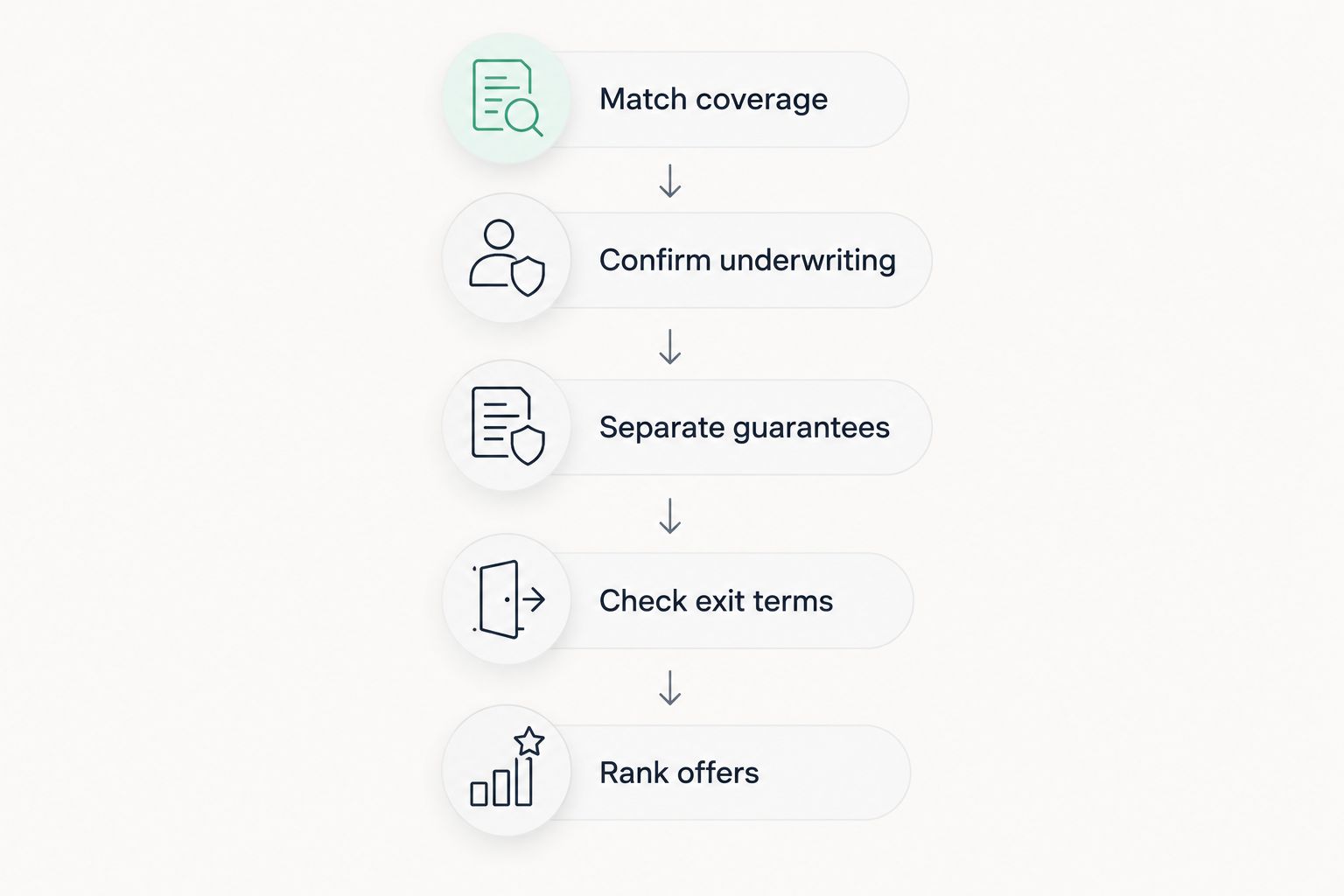
Build your 2026 company ranking only after selecting the policy structure. The process below keeps the comparison focused on equivalent protection instead of unrelated illustrations.
Match coverage
Give each seller the same requested death benefit, payment schedule, and rider requirements. Identify any proposal that changes those instructions rather than treating it as an equivalent quote.
Confirm underwriting
Record the classification used in each proposal and whether it is assumed or approved. Keep health and tobacco-use disclosures consistent across applications; accurate disclosure matters more than making the quote look favorable.
Separate guarantees
Review the guaranteed values first. Then examine any nonguaranteed illustration separately, including the assumptions behind it. Dividends on participating whole life policies are not guaranteed.
Check exit terms
Compare cash surrender values at matching policy years, loan provisions, and options if you stop paying. Cash value and cash surrender value are not interchangeable labels.
Rank offers
Order the matching offers by the required premium, then check whether the apparent winner differs on guarantees or contract terms. If the policies do not match, describe the trade-off instead of presenting a false cheapest-company result.
A comparison through Lifeinsuranceconsumers should identify the issuing insurer and policy structure. Apply the same standard to every seller you consider, including whether the proposals cover the same requirements.
How these options are ranked
The ranking prioritizes a matched underwriting comparison first, a defined payment schedule second, a reduced application process third, and health-independent acceptance fourth. These are different decision routes, not evidence that one insurer beats every other insurer on rates.
Your best option is the one that meets your coverage need with a payment obligation you can maintain. A contract that does not fit your budget is not rescued by an attractive illustration.
Which whole life insurance option should you choose?
Start with fully underwritten whole life if you can complete underwriting and want permanent coverage. Choose limited-pay when ending scheduled premiums after a defined period is a central requirement.
Consider simplified issue when the application process is your priority. Reserve guaranteed issue for situations where health-based eligibility is the main barrier, after reviewing its benefit restrictions.
If your need ends after a defined period, compare term insurance before buying whole life. Do not purchase permanent coverage merely because a company appears first in a rate-ranking article.
FAQ
Which company has the best whole life insurance rates in 2026?
The best company-level rate is determined by matching quotes for your applicant profile and policy requirements. Compare the same coverage, payment schedule, riders, and underwriting classification before naming a winner.
Can I compare whole life insurance rates by company without applying?
You can compare preliminary estimates before completing an application. An estimate based on an assumed underwriting class is not the same as an approved offer.
Is limited-pay whole life the same as fully underwritten whole life?
No. Limited-pay describes the premium-payment schedule, while fully underwritten describes the insurer's application assessment; a policy can have both features.
Does no-exam whole life insurance mean guaranteed acceptance?
No. Simplified-issue policies often avoid an examination but still use health questions or other eligibility checks; guaranteed-issue policies use a different acceptance structure.
Are whole life insurance dividends guaranteed?
No, dividends on participating whole life policies are not guaranteed. Evaluate guaranteed policy values separately from any illustration that includes future dividends.
Does guaranteed-issue whole life pay the full benefit immediately?
Not necessarily. Guaranteed-issue policies commonly have graded-benefit provisions, so read the contract's initial-period benefits and exceptions before purchasing.
Should I choose whole life insurance or term insurance?
Choose based on whether your coverage need is permanent or lasts for a defined period. Compare the payment obligations and benefits of both structures before committing to whole life insurance.
Is Lifeinsuranceconsumers the company that issues my policy?
Lifeinsuranceconsumers sells life insurance; confirm the issuing insurer on the proposal and policy documents. The insurer named in the contract is the company responsible for its contractual obligations.
One last thing
An illustration is not a promise that every displayed value will occur. Before accepting a 2026 whole life proposal, ask the seller to identify the guaranteed values and explain what changes when nonguaranteed dividends differ from the illustration.
Keep your shortlist organized by insurer, policy, underwriting status, and payment schedule—not by the seller's headline premium alone. That is how a rates list becomes a purchasing decision.